Sometimes, you need to make space. When a little course came up that was a) 5 mins by bike b) short in duration c) about a topic I want to explore and d) free, sometimes, one needs to just make it happen.
Space for putting your thinking and creative hat on and looking a bit deeper than being continuously interrupted by the needs of two children will ever allow on an every day basis.
So, we found ourselves a babysitter who can bridge those times where mummyship and daddyship don't meet to pass responsibilities over.
The course in question is about how to save the planet while saving money. Or something along those lines. Sounds good? Well it is - maybe it's because I've been so single tracked into mothering for the last year that anything other is like the bestest little treat one can ever get. Maybe it's because it comes at just the right time in my life, where my attempt to simplify my life and try and live sustainably has come to a standstill, because, truth be told, other than giving up work (which is not an option) I can't see how I can reduce my impact on our planet any further. My food growing is lovely but slightly, well, how should I put it, lacking space, time and success. The chicken won't make an appearance any time soon because while we just about have the space, it's not ideal. Getting rid of the car? Oh I've so thought it through and the answer is no.
Time to get together with like-minded people and dig deeper.
And last week, we dug into food.
My Baglady pledge was about not buying anything packaged in plastic tubs, and I've been doing reasonably well on that front; with a few exceptions (berries). Even when pledging, I found it difficult to decide whether it was better to have organic produce from South Africa or UK produce that is not organic. Now, with the help of the course, I can put labels on my conundrum.
You see, ever food has different categories to its carbon footprint, and my conundrum was between production, packaging and transport. Those three categories are complemented by the category of processing. 4 variables, 4 opportunities for putting oil into your food, yummy.
As homework, I sat down and looked through my fortnightly shopping and labelled the environmental impact of my food alongside the four categories: production, processing, packaging and transport.
It was a very useful exercise because I learned a lot.
I found out that while I try to buy local produce, that effort has so far been limited to fruit and veg. Most of other foods I buy have no label as to where it's from - so much so that I have no idea where it comes from. Cereal from Tesco's has about 10 ingredients (not good in the processing category) and there's just no way of telling where the ingredients come from or even where it's processed. The Co-op does much better on that front and their own brand Bran Flakes are from British grains, processed in the UK.
Secondly, I found out how to go further with your food in relation to reducing your environmental impact. There are some reasonably good rules of thumb:
- frozen stuff has often travelled further and has to be frozen all the way, so more energy is needed on various levels. Try to rely less on frozen foods
- If something is shipped by air, that's bad. Try to eliminate items that are flown in - fruit and veg from outside Europe will have to fly as a rule of thumb
- Food that has more than 10 ingredients is heavily processed and brings together ingredients from many different countries, thus increasing the transport energy input. Try to cook from scratch where you can or buy foods that have only a few ingredients/are not heavily processed.
- In relation to packaging - aluminium cans have a massive carbon footprint. BUT they can be recycled. So it's ok to buy them occasionally but don't dump them, do put them in the recycling bin. Plastic isn't as bad as tin and glass, and cardboard is quite ok environmentally even if you can't recycle it. Tetra packs are better than tin - which was new to me. So, given the choice: only buy aluminium/tin/glass packaging if you can and will recycle them. Try to buy loose items (though if the loose ones are flown into the country, you may be better off getting packaged items).
-east less meat, fish and dairy
Put positively:
Do buy organic
Do buy local and seasonal
Do try to buy loose or with minimal packaging (or bulk)
Do grow your own
Do cook from scratch
So, in my food diary I've realised that while I'm doing alright on the organic vegetable bag, home-grown stuff and buying local, I'm not so good on the processed food side of thing (my pet fail being ready made vegetarian dishes). I had already tried to use less of them simply because their salt content is shockingly high and that isn't good for kids, so I try to only use them once a week.
But I'm also a realist - while I'd love to cook everything from scratch, it's just not possible if you juggle kids, work and home. I used to batch cook in the evenings after the kids were in bed but now that time is me-time for blogging, reading, knitting. The balance has to be right. The exercise though has shown me how I can maintain the balance and still reduce my carbon footprint a bit further.
And, before I go, I'd like to share this film with you. It's a real gem, and touches on so many issues past, present and future, in a highly viewable way: A Farm for the Future.

Mummy do that!
Showing posts with label grow your own. Show all posts
Showing posts with label grow your own. Show all posts
Tuesday, 26 July 2011
Sunday, 20 February 2011
Seeds seeds seeds
Ding dong, the gardening year has begun, and it started with a bang.
Some while ago I blogged about the Scottish Seed Saving Network and how much I learned about the politics behind seeds. In two hours, my view on seeds was totally and utterly changed. While before I got my seeds from any old garden centre without much thought, now I know the importance of local seeds for growing success (short term) and empowered gardening for the want of a better word (long term). Growing food is also about skills, and saving seeds as well as growing from seed is a skill set that makes the food grower self sufficient. Not in an airy fairy way, it's rather about empowering anyone to grow independent from the seeds imposed on you by large scale manufacturers, who can give you whatever they like (including seeds that won't be able to produce seeds, as they already do with lots of crops).
The philosophy of the seed saving network is to promote seed saving and to exchange them for free. It's utterly not about profit, but about giving good seeds to anyone who wants to grow vegetables.
And Saturday was this years seed exchange day. I'd been waiting for it for over 6 months, since I came to know about the network. It's based in East Kilbride, just a few miles out of Glasgow, which has the advantage of being a location within the same micro climate as Glasgow, so that seeds tested and growing well will also do well in Glasgow. If anything, the seeds will be hardier than needed as East Kilbride is a bit colder than Glasgow.
I was stunned by the variety of seeds. They came packaged in small bags, just the right size to avoid wasting the seedy gold. The quantities were impressive, as was the variety. I really struggled what to do, with my limited garden space I can't possibly plant all that was on offer, yet I'd like to try out quite a few new vegetables, and that made me take much more than needed. They won't go to waste though, between neighbours, family and friends who are also growing their own, they will find a home for this season I'm sure (if you live in Scotland, and would like some seeds, do get in touch, I'm more than happy to pass some one).
Cubling found the whole event rather exciting, and was more intrigued by beekeeping than seeds, and ever so slightly subverting the oil game of the Transition Scotland Support stall.


I never thought a year ago that I could be so excited about seeds. In fact, most of my veg were garden centre pregrown because I couldn't be bothered growing from seed. How this has changed - I'm so excited about my seed collection that I can't wait to get started. In my mind there is a lot of measuring out of space going on, trying to find little spaces for another seed tray here and there.
I'm confident that these seeds will work much better than those bought in shops, and that I'll be able to actually grow something all the way from seed to harvest.
Let the growing season begin.
Some while ago I blogged about the Scottish Seed Saving Network and how much I learned about the politics behind seeds. In two hours, my view on seeds was totally and utterly changed. While before I got my seeds from any old garden centre without much thought, now I know the importance of local seeds for growing success (short term) and empowered gardening for the want of a better word (long term). Growing food is also about skills, and saving seeds as well as growing from seed is a skill set that makes the food grower self sufficient. Not in an airy fairy way, it's rather about empowering anyone to grow independent from the seeds imposed on you by large scale manufacturers, who can give you whatever they like (including seeds that won't be able to produce seeds, as they already do with lots of crops).
The philosophy of the seed saving network is to promote seed saving and to exchange them for free. It's utterly not about profit, but about giving good seeds to anyone who wants to grow vegetables.
And Saturday was this years seed exchange day. I'd been waiting for it for over 6 months, since I came to know about the network. It's based in East Kilbride, just a few miles out of Glasgow, which has the advantage of being a location within the same micro climate as Glasgow, so that seeds tested and growing well will also do well in Glasgow. If anything, the seeds will be hardier than needed as East Kilbride is a bit colder than Glasgow.
I was stunned by the variety of seeds. They came packaged in small bags, just the right size to avoid wasting the seedy gold. The quantities were impressive, as was the variety. I really struggled what to do, with my limited garden space I can't possibly plant all that was on offer, yet I'd like to try out quite a few new vegetables, and that made me take much more than needed. They won't go to waste though, between neighbours, family and friends who are also growing their own, they will find a home for this season I'm sure (if you live in Scotland, and would like some seeds, do get in touch, I'm more than happy to pass some one).
Cubling found the whole event rather exciting, and was more intrigued by beekeeping than seeds, and ever so slightly subverting the oil game of the Transition Scotland Support stall.


I never thought a year ago that I could be so excited about seeds. In fact, most of my veg were garden centre pregrown because I couldn't be bothered growing from seed. How this has changed - I'm so excited about my seed collection that I can't wait to get started. In my mind there is a lot of measuring out of space going on, trying to find little spaces for another seed tray here and there.
I'm confident that these seeds will work much better than those bought in shops, and that I'll be able to actually grow something all the way from seed to harvest.
Let the growing season begin.
Tuesday, 1 February 2011
Little exciting things
The sun is out and it's warm. There may be snow forecast for Thursday, but right now, spring is in the air. I'm full of ideas for our tiny garden and the song of birds is in my ear. Our attempt at the Big Garden Bird Watch was a bit of a fail, well, actually it wasn't. No, we didn't sit down for an hour to count birds, instead, the 8 kids we had in tow (aged 0-4) went and explored Kelvingrove Park. Fair enough. However, in preparation, Cubling and I had sat down and matched stickers to birds in her RSPB book and translated all bird names into German. I learned new bird names, realised that a coal tit is not a Kohlmeise, and Cubling has since spotted a few birds all by herself. Above all, she's interested in and excited about birds, and we've detected some early signs of spring as well.
We brought home some bulbs that had become undug by dogs and have planted them at home, they are now growing every day and I'm rather excited to find out what they turn out to be. Cubling had also brought her little magnifying container and insisted she wanted to find a bug or an ant. Not an easy task considering how bitter cold it was on Sunday, I was sure every sensible bug would be well tucked away.
Apart from a shield bug.

And they're even meant to hibernate as I've since been told! So we got a shield bug, then, as night fell at 4.30pm (do you hear my scream of despair?) we went into the museum for mummy to warm up her frozen toes. Cubling wanted to see the half tiger (they've got a tiger there with only half his skin on, the rest is not gruesome bones but a metal frame). En route she got distracted and we spotted some stuffed birds too, as well as her favourite RSPB lady whom she showed her favourite woodpecker and her shield bug (which is how I came to know it's a shield bug ;) ) The woman gave her colouring sheets of a blue tit and a robin, and yesterday morning she coloured them in, even remembering that a blue tit has a blue head and a robin has a red breast.
It was all rather successful in its own way. Who am I kidding, I never really thought she'd sit still for an hour to count birds!
Actually, this post was meant to be about food growing, as it's Tuesday and I want to instill some new springy life into Urban Food Growing Tuesday. I guess I got distracted. I'm full of good intention to put out a bit more bird food and to make bird feeders so we get more birds into our garden. At the moment, they're confined to our hedge and our neighbours do much better in the bird feeding department so they never linger in ours. Oops, sorry, distracted again.
As to growing our own - the garlic and onion sets that I'd planted just before the big freeze have survived and have green shoots which is rather impressive. I plan to get some set potatoes tomorrow to start sprouting the first lot. The rocket, basil and coriander is doing great in the conservatory. Once the ground is no longer ice solid, I'll plant out my plum tree and the soft fruit trees will go into containers. I hope to get the containers through freecycle - having been for once successful in sourcing items on freecycle, I'm rather hopeful.
There's a great initiative and I've just signed up myself - the One Pot Pledge. It's about growing just one pot of vegetables this year. A great way of trying out something new and maybe finding out how satisfying growing your own is. It doesn't have to be much, some herbs, maybe some lettuce - it's easily done and the site has lots of tips how to do it right. I've pledged to grow dwarf beans and to get at least 3 others to sign up - so if you feel inspired to sign up, it would be fab if you let me know in the comments! Ah go on, make my day!
We brought home some bulbs that had become undug by dogs and have planted them at home, they are now growing every day and I'm rather excited to find out what they turn out to be. Cubling had also brought her little magnifying container and insisted she wanted to find a bug or an ant. Not an easy task considering how bitter cold it was on Sunday, I was sure every sensible bug would be well tucked away.
Apart from a shield bug.

And they're even meant to hibernate as I've since been told! So we got a shield bug, then, as night fell at 4.30pm (do you hear my scream of despair?) we went into the museum for mummy to warm up her frozen toes. Cubling wanted to see the half tiger (they've got a tiger there with only half his skin on, the rest is not gruesome bones but a metal frame). En route she got distracted and we spotted some stuffed birds too, as well as her favourite RSPB lady whom she showed her favourite woodpecker and her shield bug (which is how I came to know it's a shield bug ;) ) The woman gave her colouring sheets of a blue tit and a robin, and yesterday morning she coloured them in, even remembering that a blue tit has a blue head and a robin has a red breast.
It was all rather successful in its own way. Who am I kidding, I never really thought she'd sit still for an hour to count birds!
Actually, this post was meant to be about food growing, as it's Tuesday and I want to instill some new springy life into Urban Food Growing Tuesday. I guess I got distracted. I'm full of good intention to put out a bit more bird food and to make bird feeders so we get more birds into our garden. At the moment, they're confined to our hedge and our neighbours do much better in the bird feeding department so they never linger in ours. Oops, sorry, distracted again.
As to growing our own - the garlic and onion sets that I'd planted just before the big freeze have survived and have green shoots which is rather impressive. I plan to get some set potatoes tomorrow to start sprouting the first lot. The rocket, basil and coriander is doing great in the conservatory. Once the ground is no longer ice solid, I'll plant out my plum tree and the soft fruit trees will go into containers. I hope to get the containers through freecycle - having been for once successful in sourcing items on freecycle, I'm rather hopeful.
There's a great initiative and I've just signed up myself - the One Pot Pledge. It's about growing just one pot of vegetables this year. A great way of trying out something new and maybe finding out how satisfying growing your own is. It doesn't have to be much, some herbs, maybe some lettuce - it's easily done and the site has lots of tips how to do it right. I've pledged to grow dwarf beans and to get at least 3 others to sign up - so if you feel inspired to sign up, it would be fab if you let me know in the comments! Ah go on, make my day!


Wednesday, 29 December 2010
The hopeless idealist's plan for 2011
I don't really do New Year's Resolutions, not sure why, but have never done them. However, for this year I thought it would be quite good to make a few plans, or maybe even commitments, so that at the end of the year I can look back and see how I did. No pressure, just to be able to see if I followed the track, got sidetrack or discovered a totally new road. Which would be fine too.
So here are my plans for 2011:
1. Get chickens. Not sure when that'll be, as it depends on a few alterations in our tiny garden. Which means it may or may not happen. Cubling is dead excited about it. And so am I, even if a bit wary of the extra work they may involve and also the fox.
2. Grow more food. I'm nowhere as near to that as I'd hoped to be which is due to the snow. There are 6 berry bushes to be planted, one fruit tree waiting for a permanent hole. Ideally, I'd also like to replace lawn with food growing area. But this may a more long term ambition.
3. Buy less in general. Buy with less packaging. Buy more ethically. Buy more handmade. Avoid plastic
4. Make all greeting cards. Now this is ambitious. I love making cards, but in this card giving land of the UK, that translates to rather a lot of card making.
5.Learn 3 new things (high in the list of contenders are crocheting, basket making and wood turning, but it may be something totally different)
6. Declutter. Difficulty with this one is that it's relative and as much as I try doing it, more clutter appears.
7. Get back to a size 12. Yes I'm shallow. I want to fit into my pre-pregnancy clothes. I think I only need to continue breastfeeding and should get there (I'm one of the lucky ones whose weight just drops off magically while breastfeeding)
8. Learn how to use Lightroom. Which would also part fulfills no. 5
9. Reduce my carbon footprint. I'm not saying by how much because I'm a chicken and it's rather difficult. Apparently mine is way over 3 earths (as in, if everyone used as much carbon as I did, we'd need 3 earths, and that's although I'm a vegetarian and trying not to waste too much...) However, I'm doing not so bad as I've reduced my air travel in the past 6 months.
10. If I can find an illustrator, I'd like to create a simple bilingual German/English toddler book. You don't happen to be an illustrator? You see, I've had this idea for a long time but can't draw for the life of me.
Bonus round:
If I'm really ambitious, I'd like to think/set up a social enterprise. I have an idea for it, but probably neither time nor energy.
So there you have it. It's all green for next year, I'm a hopeless idealist but that's just grand by me.
So here are my plans for 2011:
1. Get chickens. Not sure when that'll be, as it depends on a few alterations in our tiny garden. Which means it may or may not happen. Cubling is dead excited about it. And so am I, even if a bit wary of the extra work they may involve and also the fox.
2. Grow more food. I'm nowhere as near to that as I'd hoped to be which is due to the snow. There are 6 berry bushes to be planted, one fruit tree waiting for a permanent hole. Ideally, I'd also like to replace lawn with food growing area. But this may a more long term ambition.
3. Buy less in general. Buy with less packaging. Buy more ethically. Buy more handmade. Avoid plastic
4. Make all greeting cards. Now this is ambitious. I love making cards, but in this card giving land of the UK, that translates to rather a lot of card making.
5.Learn 3 new things (high in the list of contenders are crocheting, basket making and wood turning, but it may be something totally different)
6. Declutter. Difficulty with this one is that it's relative and as much as I try doing it, more clutter appears.
7. Get back to a size 12. Yes I'm shallow. I want to fit into my pre-pregnancy clothes. I think I only need to continue breastfeeding and should get there (I'm one of the lucky ones whose weight just drops off magically while breastfeeding)
8. Learn how to use Lightroom. Which would also part fulfills no. 5
9. Reduce my carbon footprint. I'm not saying by how much because I'm a chicken and it's rather difficult. Apparently mine is way over 3 earths (as in, if everyone used as much carbon as I did, we'd need 3 earths, and that's although I'm a vegetarian and trying not to waste too much...) However, I'm doing not so bad as I've reduced my air travel in the past 6 months.
10. If I can find an illustrator, I'd like to create a simple bilingual German/English toddler book. You don't happen to be an illustrator? You see, I've had this idea for a long time but can't draw for the life of me.
Bonus round:
If I'm really ambitious, I'd like to think/set up a social enterprise. I have an idea for it, but probably neither time nor energy.
So there you have it. It's all green for next year, I'm a hopeless idealist but that's just grand by me.
Tuesday, 9 November 2010
A special present - Urban food growing Tuesday
My mummy friends gave me an extra special present - a plum tree.
It doesn't look like much right now, it's autumn after all, but I can't wait to see what it'll look like in the spring.
I've read up all about plum trees and know that this one is a great variety for small spaces and semi shade. So it should grow well. Now I only have to decide whether to plant it in the front or back - probably it'll be the front as it has good soil (though less sunshine) - our back garden is either built up or a lawn, not much potential for growing a tree, even if it's a small one.
4 weeks to go until I can dig!

I've also come across a fab network of food growers in the UK. Definitely worth checking out and joining.
If you grow your own in urban spaces, please add a link to any blog posts about your efforts/experiences in the Linky tool below.
It doesn't look like much right now, it's autumn after all, but I can't wait to see what it'll look like in the spring.
I've read up all about plum trees and know that this one is a great variety for small spaces and semi shade. So it should grow well. Now I only have to decide whether to plant it in the front or back - probably it'll be the front as it has good soil (though less sunshine) - our back garden is either built up or a lawn, not much potential for growing a tree, even if it's a small one.
4 weeks to go until I can dig!

I've also come across a fab network of food growers in the UK. Definitely worth checking out and joining.
If you grow your own in urban spaces, please add a link to any blog posts about your efforts/experiences in the Linky tool below.
Tuesday, 26 October 2010
all set: growing in winter
The cold season has most definitely arrived. Two nights of frost and markedly colder days have surprised me. Autumn is my favourite season, in a melancholic kind of way. What I love about autumn are the colours, the transformation and preparation for winter. There's so much to explore outdoors, and indoors the preparation for winter, getting the warm clothes out, making jam, the business of the various festivals ahead of us (doubled for our bicultural family). I look forward to doing things indoors, making the home cosy.
And yet, every year, I get surprised by the sudden arrival of the cold season. I feel so very cold, reluctant to go out, and wonder how I'm going to make it through the winter. Oh and that clock changing thing - it makes me really irritable. Then, things fall back into some sort of swing and the cold stops feeling so cold.
This year, I have a lot of plans for my garden, yet can't do much physical work. So what better than to plant some easy growing winter crops, namely garlic and onions? Garlic is so healthy for you, and easy to grow - just separate the cloves from any bulb that you buy and plant them in good soil where you weren't growing garlic recently. Thanks to Homemademummy, I now also have a batch of winter growing onion sets. One raised bed is already cleared and the other one will be this week after the frost destroyed the still growing pumpkins, and if I have spare onions, they'll go to my neighbour who also grows her own.
This is the beauty of growing your own, the generosity and spirit of sharing. A pumpkin to carve from my SIL's garden, tatties, carrots and tomatoes from my FIL's garden, onion sets from a blogger, a total stranger. Sharing seeds, sets, plants and crops really is something very special, it brings people together and it feels so good to give and receive, it's always a very special gift because effort and love has gone into it, and yet it also comes free, it's a gift from nature, which is therefore only to be passed on as a gift. A bit like knitting, where the value is the love and manual labour, which you simply cannot put a value against - you can't ever make profit out of knitting, and therefore knitted items can really only be gifted.
This is the season of preparing the garden for winter, clearing all the old growth and it's a gift in itself that there will be some winter crops, overwintering just like us.
::This post is part of Urban Food Growing Tuesday. If you grow your own in urban spaces, no matter how small, and you blog about it, please share your post in the linky list below, which is open for one week::
And yet, every year, I get surprised by the sudden arrival of the cold season. I feel so very cold, reluctant to go out, and wonder how I'm going to make it through the winter. Oh and that clock changing thing - it makes me really irritable. Then, things fall back into some sort of swing and the cold stops feeling so cold.
This year, I have a lot of plans for my garden, yet can't do much physical work. So what better than to plant some easy growing winter crops, namely garlic and onions? Garlic is so healthy for you, and easy to grow - just separate the cloves from any bulb that you buy and plant them in good soil where you weren't growing garlic recently. Thanks to Homemademummy, I now also have a batch of winter growing onion sets. One raised bed is already cleared and the other one will be this week after the frost destroyed the still growing pumpkins, and if I have spare onions, they'll go to my neighbour who also grows her own.
This is the beauty of growing your own, the generosity and spirit of sharing. A pumpkin to carve from my SIL's garden, tatties, carrots and tomatoes from my FIL's garden, onion sets from a blogger, a total stranger. Sharing seeds, sets, plants and crops really is something very special, it brings people together and it feels so good to give and receive, it's always a very special gift because effort and love has gone into it, and yet it also comes free, it's a gift from nature, which is therefore only to be passed on as a gift. A bit like knitting, where the value is the love and manual labour, which you simply cannot put a value against - you can't ever make profit out of knitting, and therefore knitted items can really only be gifted.
This is the season of preparing the garden for winter, clearing all the old growth and it's a gift in itself that there will be some winter crops, overwintering just like us.
Tuesday, 28 September 2010
Things to sow in September - Urban Food Growing Tuesday
Unsurprisingly, my plans for growing food in my garden have not received the attention they deserve. I guess I'm growing someone much more important at the moment ;)
But but but, let that not be an excuse to share some of the fruits of my research which I ventured into while 9 months pregnant.
Not having done awfully well on the harvest side of food growing (garden is still filled with leaves, but with very few edible fruits), I was rather keen on finding out what can be grown from now to winter. It took a little while to pull all the suggestions together and for the benefit of anyone asking the same question, here's what you can sow and plant in September and October. Bear in mind the information may not be for exactly your climate - it should work in most parts of the UK unless we get another frosty winter (in which case some of these plants may not make it).
If you have any experience planting vegetables over the winter and have some top tips to share, please do! I'm really not an expert and don't know if all or just some of these work, or if there's anything that can help things along a bit.
For my part, I've sown rocket, basil and coriander in the conservatory (which is cold at night and on cloudy days but very warm as soon as the sun shines) and at least they've come up. I've planted spinach outdoors which doesn't grow much at present, and planning to do a few set garlic coz they're easy. I don't have a greenhouse or cloches, but may try some winter lettuce under empty water bottles which can be used as cloches (not pretty but functional).
Other than that I'm looking forward to catching up with my local vegetable growing friends tonight, with the hope of setting up a busy bee rota, where we help in each other's gardens and make things happen with a few more helping hands. A great idea which will make a massive difference to all our gardens big or small. I feel a bit guilty about that one, what with not being able to do much gardening in the next few weeks due to c-section recovery, and I don't like to take help without being able to return it. But maybe I need to leave my pride at home because the only way to my raspberry patch for next year will be with some help. And I will return the favour eventually of course!
So here's the list for your autumn sowing and planting:
September:
- lettuce (ideally cover with cloches)
- spring cabbage
- spinach
- endive
- overwintering onions
- turnips
In October you can sow:
- rocket
- mibuna and mizuna (I don't know what they are either)
- early peas (under cloches)
- winter lettuce
and plant out:
- onion sets
- garlic sets
- broad beans (under cloches)
- rhubarb
It's also the season to plant out any fruit and soft fruit trees, but you can apparently do that in any month that has an "r" in its name. As ever, if you've been busy growing food, please add your bloggy goodness in the linky below.
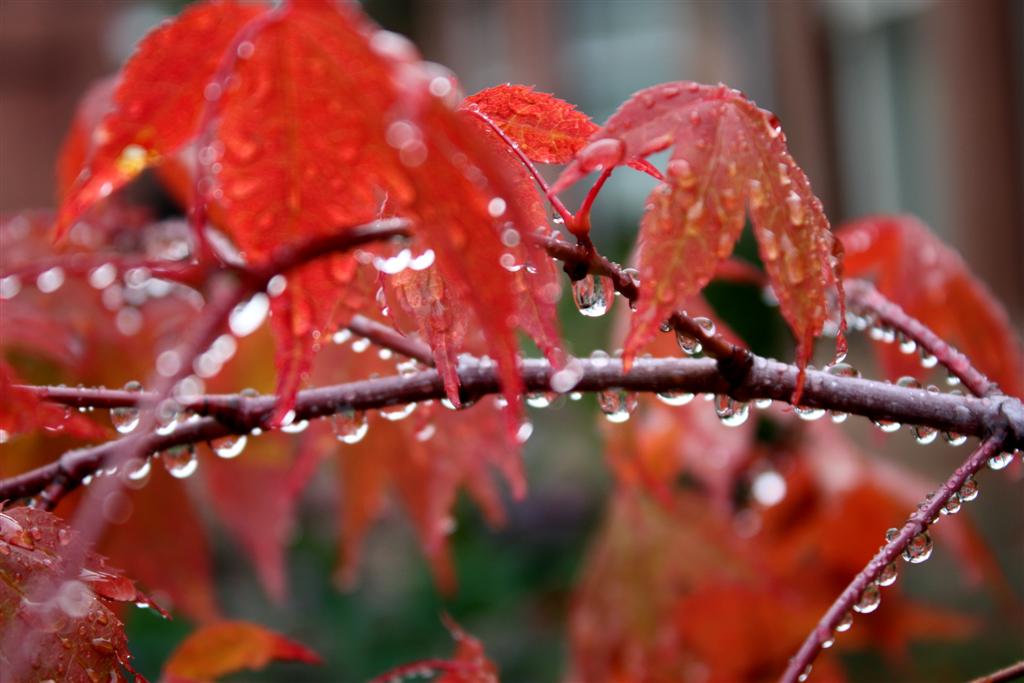
And rather randomly (if you're still reading), here's a photo of my lovely acer (which was a birthday present last year) in all its autumn glory after the Great Rain the other day:

But but but, let that not be an excuse to share some of the fruits of my research which I ventured into while 9 months pregnant.
Not having done awfully well on the harvest side of food growing (garden is still filled with leaves, but with very few edible fruits), I was rather keen on finding out what can be grown from now to winter. It took a little while to pull all the suggestions together and for the benefit of anyone asking the same question, here's what you can sow and plant in September and October. Bear in mind the information may not be for exactly your climate - it should work in most parts of the UK unless we get another frosty winter (in which case some of these plants may not make it).
If you have any experience planting vegetables over the winter and have some top tips to share, please do! I'm really not an expert and don't know if all or just some of these work, or if there's anything that can help things along a bit.
For my part, I've sown rocket, basil and coriander in the conservatory (which is cold at night and on cloudy days but very warm as soon as the sun shines) and at least they've come up. I've planted spinach outdoors which doesn't grow much at present, and planning to do a few set garlic coz they're easy. I don't have a greenhouse or cloches, but may try some winter lettuce under empty water bottles which can be used as cloches (not pretty but functional).
Other than that I'm looking forward to catching up with my local vegetable growing friends tonight, with the hope of setting up a busy bee rota, where we help in each other's gardens and make things happen with a few more helping hands. A great idea which will make a massive difference to all our gardens big or small. I feel a bit guilty about that one, what with not being able to do much gardening in the next few weeks due to c-section recovery, and I don't like to take help without being able to return it. But maybe I need to leave my pride at home because the only way to my raspberry patch for next year will be with some help. And I will return the favour eventually of course!
So here's the list for your autumn sowing and planting:
September:
- lettuce (ideally cover with cloches)
- spring cabbage
- spinach
- endive
- overwintering onions
- turnips
In October you can sow:
- rocket
- mibuna and mizuna (I don't know what they are either)
- early peas (under cloches)
- winter lettuce
and plant out:
- onion sets
- garlic sets
- broad beans (under cloches)
- rhubarb
It's also the season to plant out any fruit and soft fruit trees, but you can apparently do that in any month that has an "r" in its name. As ever, if you've been busy growing food, please add your bloggy goodness in the linky below.
And rather randomly (if you're still reading), here's a photo of my lovely acer (which was a birthday present last year) in all its autumn glory after the Great Rain the other day:
Tuesday, 7 September 2010
Urban Food Growing Tuesday: Compost!
When we moved into our new home, I was pleased that it came with one of those black composting bins. I was eager to compost all our kitchen waste, grass cuttings and hedge trimmings.
Two years later, the bin was full of slimy and disgusting stuff. Composting looked like a big fail. I didn't even know what I'd done wrong.
Thankfully, I found out what the problem was: apparently, there's two groups of compost materials, a green group (vegetable peelings/fruit scraps, cut flowers/grass, teabags, coffee grounds) and a brown group (cardboard, eggshells, crunched up paper, shredded branches and twigs). While it's not essential to layer these groups, they have to be present in some sort of balance, ideally 50-50%, and mine had too little brown stuff. The solution was to turn the compost and add some brown material as I went along. I also learned that having your compost bin stand on a slab of stone is not conducive to good composting action. It's much better to have it stood on grass or bare soil. Waste Aware Scotland has some great resources on how to compost the right way, including a very handy sheet on how to compost at home. They also have a subsidised scheme of home composting bins (and I'm sure something similar will exist in other parts of the country).
Now, turning the compost didn't sound very appealing while I was suffering from Pelvic Girdle Pain and could barely move, nor does it sound appealing in your last weeks of pregnancy. However, I still decided to open the lid and see what I could do.
And magically, the compost had lost all sliminess, presenting itself odourless as it should be, with a rather nice consistency. Ready for sieving! So a sieve was bought, and this weekend, I set myself to work. At least half of the material in the bin was degraded sufficiently to be used as compost, lovely looking stuff, just the right mix of organic matter and ash. All the material that didn't sieve went back into the bin, as a good grounding for the next batch.
Somehow I managed to make compost without ever turning it and even not getting the mix right. It took much longer, but it still worked. Still, I'll make sure that this time, there'll be enough brown stuff just because I really don't fancy ever having to turn a slimy compost heap. There are limits to my enthusiasm.
For now, I've got plenty of compost ready for planting a winter crop, plus space in the compost bin for all my kitchen and garden waste. I'm rather pleased. And below is a rather unrelated photo of our tatties harvest from last week. The red ones clearly did better.
 If you're growing your own food in urban areas, please do link your recent blog post in the linky tool below. It's open for a week from today and the idea is to share your tips, successes and learning. If you don't blog about growing your own, you can still leave a comment with anything you'd like to add.
Two years later, the bin was full of slimy and disgusting stuff. Composting looked like a big fail. I didn't even know what I'd done wrong.
Thankfully, I found out what the problem was: apparently, there's two groups of compost materials, a green group (vegetable peelings/fruit scraps, cut flowers/grass, teabags, coffee grounds) and a brown group (cardboard, eggshells, crunched up paper, shredded branches and twigs). While it's not essential to layer these groups, they have to be present in some sort of balance, ideally 50-50%, and mine had too little brown stuff. The solution was to turn the compost and add some brown material as I went along. I also learned that having your compost bin stand on a slab of stone is not conducive to good composting action. It's much better to have it stood on grass or bare soil. Waste Aware Scotland has some great resources on how to compost the right way, including a very handy sheet on how to compost at home. They also have a subsidised scheme of home composting bins (and I'm sure something similar will exist in other parts of the country).
Now, turning the compost didn't sound very appealing while I was suffering from Pelvic Girdle Pain and could barely move, nor does it sound appealing in your last weeks of pregnancy. However, I still decided to open the lid and see what I could do.
And magically, the compost had lost all sliminess, presenting itself odourless as it should be, with a rather nice consistency. Ready for sieving! So a sieve was bought, and this weekend, I set myself to work. At least half of the material in the bin was degraded sufficiently to be used as compost, lovely looking stuff, just the right mix of organic matter and ash. All the material that didn't sieve went back into the bin, as a good grounding for the next batch.
Somehow I managed to make compost without ever turning it and even not getting the mix right. It took much longer, but it still worked. Still, I'll make sure that this time, there'll be enough brown stuff just because I really don't fancy ever having to turn a slimy compost heap. There are limits to my enthusiasm.
For now, I've got plenty of compost ready for planting a winter crop, plus space in the compost bin for all my kitchen and garden waste. I'm rather pleased. And below is a rather unrelated photo of our tatties harvest from last week. The red ones clearly did better.

Tuesday, 31 August 2010
Urban Food Growing Tuesday:
The weather has been magnificent but at 39 weeks pregnant, there's only so much you can do even in a tiny garden. Still, there's planning and harvesting to be done:
What I grew this year and some attempt at summarising my relative gardening successes and failures:
- My sunflowers are starting to bloom (see yesterday's post) and it makes such a difference to see - maybe I can even get a few seeds out of them? Who knows.
- Potatoes: Cubling helped me harvest the last two of three pots of potatoes. The pots were the biggest flower pots I had, but still not particularly large. One of them had a decent yield. I know what I did wrong: I should have planted the potatoes deep and then added compost to them as they grew (which I did partly with the one pot that had a good yield). So I'm all set for a much better harvest next year. For now, we have enough for the next month, which is pretty amazing considering I just stuck some potatoes into soil and let them be.
- Cabbage: Out of all the cabbage I planted in my raised beds, one is forming a head, but I guess the leaves can be eaten too. Of course there's lots of butterflies having a meal as well.
- Leeks: I planted leeks between cabbage and broccoli, but they didn't get any sunshine because of the massive cabbage leaves and haven't grown at all. I wonder if they may still grow now that the cabbages and broccoli have been thinned out
- Beans: full fail - all three plants that I planted out got eaten up. Not sure by what, but there are only stalks left
- Courgettes: tiny fruit, leaves full of mildew. I remembered that I'd planted courgettes in the same raised bed last year so this may be why they didn't do so well.
- Pumpkin: one plant has grown properly but no flowers or fruit to speak of yet. I'm still hoping.
- Spinach: I planted out spinach a couple of weeks ago but it doesn't seem to have grown at all. I have this problem with spinach all the time, although it should be ideal for the Scottish climate. A shame really because it's my favourite veg and I don't get why it doesn't grow.
- Lettuce: most of my lettuce did well initially, then got eaten by aphids , one lettuce got spared and is still doing well.
- Soft fruit: I had a handful of raspberries, brambles didn't grow and strawberries didn't go red. They all grow in small containers so I wonder if that's the problem.
- Herbs: Mint is growing well, shame I don't like it, chives look a bit ill, sage needs treated.
Plans for next year, with some action to be taken during the autumn:
Front garden jobs:
- Put lime on front garden which is rich in clay and add manure in early spring
- Thin out plants in front garden that are old and no longer nice (it's all flowers and there's plenty of need for improving the borders)
- The old and woody sage plant in the front needs thinned out. In its place (with some cuttings) I'd like to put a herb garden of herbs that can grow in semi shade.
Back garden jobs:
- I'd like to plant raspberries in raised beds along one fence, taking out half of the slabbed path. For this, I need to find out if raspberries will grow well in containers.
- Now that some of my larger containers are empty, plant winter veg in them.
- Talk nicely to leeks and spinach so that they grow a bit more.
General:
- As both front and back are quite shaded, I plan to research any veg that does well in semi shade and shade, to avoid disappointment form this year when lots of my plants didn't do well even in the south facing patches. Similarly, most of my garden grows in containers so whatever I plant, it needs to be able to deal with container location.
- I must avoid overplanting. It just doesn't make sense to plant too close and then not end up with anything edible.
- Source manure to improve the soil
- Turn the compost bin content and add brown matter to it so it may actually become usable compost
I'm also considering getting 2 or 3 hens - not necessarily super soon, but I'd like to find out more about it, how they can be kept, how much work they involve. Then there's my hope for an apple tree. I haven't got the faintest idea where to put it, but I wants one.
What have you been up to in your gardens, containers, window sills or community gardens this past week? If you've written about it, please share your link in the linky below, or if you haven't, just use the comment box.
What I grew this year and some attempt at summarising my relative gardening successes and failures:
- My sunflowers are starting to bloom (see yesterday's post) and it makes such a difference to see - maybe I can even get a few seeds out of them? Who knows.
- Potatoes: Cubling helped me harvest the last two of three pots of potatoes. The pots were the biggest flower pots I had, but still not particularly large. One of them had a decent yield. I know what I did wrong: I should have planted the potatoes deep and then added compost to them as they grew (which I did partly with the one pot that had a good yield). So I'm all set for a much better harvest next year. For now, we have enough for the next month, which is pretty amazing considering I just stuck some potatoes into soil and let them be.
- Cabbage: Out of all the cabbage I planted in my raised beds, one is forming a head, but I guess the leaves can be eaten too. Of course there's lots of butterflies having a meal as well.
- Leeks: I planted leeks between cabbage and broccoli, but they didn't get any sunshine because of the massive cabbage leaves and haven't grown at all. I wonder if they may still grow now that the cabbages and broccoli have been thinned out
- Beans: full fail - all three plants that I planted out got eaten up. Not sure by what, but there are only stalks left
- Courgettes: tiny fruit, leaves full of mildew. I remembered that I'd planted courgettes in the same raised bed last year so this may be why they didn't do so well.
- Pumpkin: one plant has grown properly but no flowers or fruit to speak of yet. I'm still hoping.
- Spinach: I planted out spinach a couple of weeks ago but it doesn't seem to have grown at all. I have this problem with spinach all the time, although it should be ideal for the Scottish climate. A shame really because it's my favourite veg and I don't get why it doesn't grow.
- Lettuce: most of my lettuce did well initially, then got eaten by aphids , one lettuce got spared and is still doing well.
- Soft fruit: I had a handful of raspberries, brambles didn't grow and strawberries didn't go red. They all grow in small containers so I wonder if that's the problem.
- Herbs: Mint is growing well, shame I don't like it, chives look a bit ill, sage needs treated.
Plans for next year, with some action to be taken during the autumn:
Front garden jobs:
- Put lime on front garden which is rich in clay and add manure in early spring
- Thin out plants in front garden that are old and no longer nice (it's all flowers and there's plenty of need for improving the borders)
- The old and woody sage plant in the front needs thinned out. In its place (with some cuttings) I'd like to put a herb garden of herbs that can grow in semi shade.
Back garden jobs:
- I'd like to plant raspberries in raised beds along one fence, taking out half of the slabbed path. For this, I need to find out if raspberries will grow well in containers.
- Now that some of my larger containers are empty, plant winter veg in them.
- Talk nicely to leeks and spinach so that they grow a bit more.
General:
- As both front and back are quite shaded, I plan to research any veg that does well in semi shade and shade, to avoid disappointment form this year when lots of my plants didn't do well even in the south facing patches. Similarly, most of my garden grows in containers so whatever I plant, it needs to be able to deal with container location.
- I must avoid overplanting. It just doesn't make sense to plant too close and then not end up with anything edible.
- Source manure to improve the soil
- Turn the compost bin content and add brown matter to it so it may actually become usable compost
I'm also considering getting 2 or 3 hens - not necessarily super soon, but I'd like to find out more about it, how they can be kept, how much work they involve. Then there's my hope for an apple tree. I haven't got the faintest idea where to put it, but I wants one.
What have you been up to in your gardens, containers, window sills or community gardens this past week? If you've written about it, please share your link in the linky below, or if you haven't, just use the comment box.
Tuesday, 24 August 2010
Some fab initiatives for Urban Food Growing Tuesday
Last week wasn't the best for actual food growing in my little patch. A lot of rain, then general business and illness. However, I've been inspired by a few blogposts and initiatives not to let my urban food growing Tuesday lag, so today I'd like to introduce a few initiatives and tips.
The thing about initiatives and organisations is that they are often local but there's nothing preventing them to be replicated in other places. Often it just takes one person who gives it a kick start and if there's one thing I've noticed recently it's that the social networking world has facilitated the process. Most initiatives now have their facebook page and personally I love joining and keeping up with what's happening, you never miss a date for your diary (even if you can't make it) and it's easy to get involved.
Last week I already spoke about the East Kilbride Development Trust and their seed bank initiative. I think it's a fabulous idea and something that could happen anywhere really. The trust also works with local primary schools developing food gardens, something which is close to my heart because I saw the impact it can have and the enthusiasm it can create in a very short period of time.
NVA is a public arts organisation with a focus on urban and rural landscapes and how people can shape them. One of their current projects is SAGE (Sow and Grow Everywhere) which encourages creative uses of places and containers to grow food, culminating in the Glasgow Harvest, a massive public harvest sharing event at Glasgow's Tramway Theatre this Saturday 28th August. The idea is that the rather private experience of gardening is shared collectively, including cooking with the produce and making jams. There's a great Q&A about them here.
The Fife Diet came about in 2007 when consumers signed up for a challenge to eat locally produced food only for a year, and to share how they got on. It's about re-localisation of food, cutting down on food miles but also supporting the local economy. More than that, it's about rethinking food in terms of sustainability, i.e. working towards a future where food may not be as easily transported from across the world and where we may well have to rely on locally sourced food.The Fife Diet can be found on Facebook and on Twitter.
GROW Glasgow is based in the West End of Glasgow and you can follow their activities on their facebook page. They aim
Urban Roots are based in the Southside of Glasgow. They run a community garden, a food coop, have a woodland area, environmental art projects and food growing courses amongst other things. You can follow their activities on facebook too. A lot of it is done by volunteers, so for instance you can join the Sunday gardening session at the community garden as a volunteer.
All these initiatives/organisations show how with a bit of imagination, you can get lots of people involved in growing food in cities, and spread the goodness of it all.
Now I'd love to hear about your week in urban food growing. If you've blogged about it, or want to share some link you've come across, please use the linky below.
The thing about initiatives and organisations is that they are often local but there's nothing preventing them to be replicated in other places. Often it just takes one person who gives it a kick start and if there's one thing I've noticed recently it's that the social networking world has facilitated the process. Most initiatives now have their facebook page and personally I love joining and keeping up with what's happening, you never miss a date for your diary (even if you can't make it) and it's easy to get involved.
Last week I already spoke about the East Kilbride Development Trust and their seed bank initiative. I think it's a fabulous idea and something that could happen anywhere really. The trust also works with local primary schools developing food gardens, something which is close to my heart because I saw the impact it can have and the enthusiasm it can create in a very short period of time.
NVA is a public arts organisation with a focus on urban and rural landscapes and how people can shape them. One of their current projects is SAGE (Sow and Grow Everywhere) which encourages creative uses of places and containers to grow food, culminating in the Glasgow Harvest, a massive public harvest sharing event at Glasgow's Tramway Theatre this Saturday 28th August. The idea is that the rather private experience of gardening is shared collectively, including cooking with the produce and making jams. There's a great Q&A about them here.
The Fife Diet came about in 2007 when consumers signed up for a challenge to eat locally produced food only for a year, and to share how they got on. It's about re-localisation of food, cutting down on food miles but also supporting the local economy. More than that, it's about rethinking food in terms of sustainability, i.e. working towards a future where food may not be as easily transported from across the world and where we may well have to rely on locally sourced food.The Fife Diet can be found on Facebook and on Twitter.
GROW Glasgow is based in the West End of Glasgow and you can follow their activities on their facebook page. They aim
- To encourage and increase production of organic vegetables in the West End
- Facilitate a garden sharing scheme
- Work towards setting up community gardens
- To promote a tangile sense of community through team work and sustainable agricultural development
Urban Roots are based in the Southside of Glasgow. They run a community garden, a food coop, have a woodland area, environmental art projects and food growing courses amongst other things. You can follow their activities on facebook too. A lot of it is done by volunteers, so for instance you can join the Sunday gardening session at the community garden as a volunteer.
All these initiatives/organisations show how with a bit of imagination, you can get lots of people involved in growing food in cities, and spread the goodness of it all.
Now I'd love to hear about your week in urban food growing. If you've blogged about it, or want to share some link you've come across, please use the linky below.
Tuesday, 17 August 2010
Urban Food Growing: All about seeds
I'd never really thought much about seeds. My approach was firmly rooted in buying them in garden centres, and planting them. Just that somehow, I've not been particularly successful at growing from seed. Well, now I know why this could be.
Matthew Love from the East Kilbride Development Trust took our food growing course session on a tour de force in his presentation/talk on seed saving. It's rare to learn so many new things in just an hour, and it was mindset changing stuff. Did you know that the seeds you get to buy are really rather rubbish because they are the cast offs from the agricultural industry? The farmers get the good seeds, gardeners get the shite ones, so little wonder we're not doing too well on the planting from seed front.
What's more, seeds on the market are controlled by seed producers who have to register seeds. This is expensive and leads to a reduction in variety of seeds. So localised seeds are become rare and are not available commercially. We're losing variety, and particularly that which grows well right here.
The seeds that are on the market are more often than not aimed at industrial production of food, which is done differently to the food growing of your average gardener. For example, if you grow peas on a farm, you will be looking for a low growing variety that can be harvested by combine harvesters. If you are a gardener, you obviously don't have a combine harvester and don't need low growing peas. In fact, your garden would make much more efficient use of space if your peas were high growing so you can use the other space for lettuces.
And finally, because most of agricultural mass production of food is done in countries with a bit more sun than the west coast of Scotland, the seeds are of mediterranean origin which doesn't make for great growing in Scotland.
What the urban food grower needs are seeds which work well in the local climate and makes best use of what that climate is like. This is even different between Glasgow and Fife, so local really means a rather small area. The East Kilbride Development Trust has a perfectly simple but inspiring answer to the seed conundrum: Saving seeds from vegetables that grow well locally, either through existing knowledge of varieties that do grow well or by trial and error. Then, swap the seeds. The whole ideology is that of making seeds available and enabling local food growing, so the seeds are always free. Ingenious.
Matthew is in the process of developing seed saving network for Scotland which will contribute to affordable and sustainable food growing, while develop seed knowledge and enabling people to be more self reliant. He runs an annual seed exchange event and I can already not wait for it to happen some time in early 2011 (although to be fair I walked away with more seeds than I can plant in my small space in the coming year as it is).
There were also lots of tips on how to save seeds yourself as well as general gardening advice. I know what I did wrong this year now and can avoid my mistakes next year. I also walked away with half a cherry tomato, of the winner in Matthew's tomato growing test - a cherry tomato that will do well in our climate. Half a tomato which will give me about 30 seeds. Method: scoop out seeds into a jar, add some water, stand for 3 days until the gooey stuff around the seeds gets mouldy and separates from seeds. Then wash away the mould, catching the seeds. Dry off and leave to dry for a few days. Store in a cool, dark and dry place until next spring.
Find out more about tips that the East Kilbride Development Trust has on growing food, and join the mailing list if you're interested in the project. If you're in Scotland and interested in growing food, I can only recommend to contact Matthew about the seed exchange project.
Now it's your turn to share your food growing stories!
Matthew Love from the East Kilbride Development Trust took our food growing course session on a tour de force in his presentation/talk on seed saving. It's rare to learn so many new things in just an hour, and it was mindset changing stuff. Did you know that the seeds you get to buy are really rather rubbish because they are the cast offs from the agricultural industry? The farmers get the good seeds, gardeners get the shite ones, so little wonder we're not doing too well on the planting from seed front.
What's more, seeds on the market are controlled by seed producers who have to register seeds. This is expensive and leads to a reduction in variety of seeds. So localised seeds are become rare and are not available commercially. We're losing variety, and particularly that which grows well right here.
The seeds that are on the market are more often than not aimed at industrial production of food, which is done differently to the food growing of your average gardener. For example, if you grow peas on a farm, you will be looking for a low growing variety that can be harvested by combine harvesters. If you are a gardener, you obviously don't have a combine harvester and don't need low growing peas. In fact, your garden would make much more efficient use of space if your peas were high growing so you can use the other space for lettuces.
And finally, because most of agricultural mass production of food is done in countries with a bit more sun than the west coast of Scotland, the seeds are of mediterranean origin which doesn't make for great growing in Scotland.
What the urban food grower needs are seeds which work well in the local climate and makes best use of what that climate is like. This is even different between Glasgow and Fife, so local really means a rather small area. The East Kilbride Development Trust has a perfectly simple but inspiring answer to the seed conundrum: Saving seeds from vegetables that grow well locally, either through existing knowledge of varieties that do grow well or by trial and error. Then, swap the seeds. The whole ideology is that of making seeds available and enabling local food growing, so the seeds are always free. Ingenious.
Matthew is in the process of developing seed saving network for Scotland which will contribute to affordable and sustainable food growing, while develop seed knowledge and enabling people to be more self reliant. He runs an annual seed exchange event and I can already not wait for it to happen some time in early 2011 (although to be fair I walked away with more seeds than I can plant in my small space in the coming year as it is).
There were also lots of tips on how to save seeds yourself as well as general gardening advice. I know what I did wrong this year now and can avoid my mistakes next year. I also walked away with half a cherry tomato, of the winner in Matthew's tomato growing test - a cherry tomato that will do well in our climate. Half a tomato which will give me about 30 seeds. Method: scoop out seeds into a jar, add some water, stand for 3 days until the gooey stuff around the seeds gets mouldy and separates from seeds. Then wash away the mould, catching the seeds. Dry off and leave to dry for a few days. Store in a cool, dark and dry place until next spring.
Find out more about tips that the East Kilbride Development Trust has on growing food, and join the mailing list if you're interested in the project. If you're in Scotland and interested in growing food, I can only recommend to contact Matthew about the seed exchange project.
Now it's your turn to share your food growing stories!
Wednesday, 11 August 2010
Introducing: Urban food growing Tuesday
I know, I know, it's Wednesday, and pretty late in the day at that. Thing is, I've been going to this Grow More Food gardening course which Urban Roots put on for the past 7 weeks and well, it's been a Tuesday kind of thing. To honour the inspiration (and kick in the arse) it's given me, as well as to keep the momentum going for me personally but maybe also for anyone interested in urban gardening, I thought I'd introduce an Urban Food Growing Tuesday.
Nice one, no?
So, what's it about?
Well, I live in a big city, in the suburbs (although it's not your average suburbia). Our house is a tiny mid terrace with a small garden. I used to have an allotment when I was still in a tenement flat, so allotment gardening is not a stranger to me. I enjoy growing things, and I've always been more into growing food than flowers. Growing food in urban spaces has particular challenges but also rewards. Above all, I have to admit that after all those years of having an allotment and trying to get a yield out of our garden, I'm not particularly good at it. I do want to get better, and I'm sure I'm not the only one struggling in their urban patch! So, wouldn't it be great if other bloggers into growing food would join in to share their successes, failures, tips and ideas? With Urban Food Growing Tuesday I'd like to create a space to share our journeys in urban food growing. If you blog about growing food, add your URL in linky below, simple as that. I might even come up with a badge if I feel creative. The linky will be open for a week from the date of my post (so usually from Tuesday to Wednesday).
One thing I felt rather bad about is that at most sessions of the Grow more Food course, I had very little of progress to report from my tiny gardening space. Of course there are reasons, so today I decided to try and cook from our garden. We had a handful of sprouting broccoli, two handful of spinach, 8 potatoes and topped it up with eggs, bread and sweetcorn, all sauted in butter. Cubling helped me dig up the tatties and was mightily proud of her harvest, and low and behold, ate her full meal (including the spinach which she usually refuses). It was tasty. I mean it, the yield might have been pathetic but the taste of it was just so much better than anything you will get from the supermarket.
That's the good bit. The bad bit is that the yield really hasn't been good this year. I didn't get a single red strawberry, my courgettes are the size of tiny gherkins, and as to the broccoli - well I waited for proper heads to appear only to see them go to flower, unsure if that meant I'd lost my chance or not. I messed up the tatties too, and the 8 small (if tasty ones) we dug up today were the yield of 3 plants.
So, putting into practice what I learned at the course, I looked at the site tonight, as we had dinner in the garden (request by Cubling, she likes the wind and wanted to eat in the wind). While our back garden is south facing (ideal), the sun is obscured by 3 sycamore trees growing on our neighbour's patch, one ash tree in our garden (which we prune to reduce the impact), a high fence to the south, a high hedge to the west, and a low fence to the east. From August, this means no sunshine after 1pm in any of the planted area of the garden - not good. The garden is mainly grass, with a few slabs for paths. To plant food, I have 2 raised beds and a significant collection of tubs.
Our front garden is north facing (not good) but on the plus side does not suffer from additional lack of sunshine. It's a grass area, with flowers, bulbs and shrubs on the edges and a new and small acer tree in the middle. Not an ideal site for food growing, and we'd be the first in the area to have food growing in the front.
A further challenge is that we are in Scotland. The growing season is shorter than in England, the climate in the west of Scotland is wet and with less hours of sun than even in the east. So far, nobody in their sane mind has suggested a Strathclyde diet (where you only eat food produced in the local area) because we know that this would probably lead to serious deficiencies. That doesn't mean though that you can't grow food here - you just have a few extra challenges to deal with and need to be more creative.
My plan for the week to come: consider what I can plant now in the spaces that have become available, but also making a plan for next year, which may expand the food growing area, and prioritise my ambitions for the space (chickens or apple tree?). Let's see what the week will bring.
Nice one, no?
So, what's it about?
Well, I live in a big city, in the suburbs (although it's not your average suburbia). Our house is a tiny mid terrace with a small garden. I used to have an allotment when I was still in a tenement flat, so allotment gardening is not a stranger to me. I enjoy growing things, and I've always been more into growing food than flowers. Growing food in urban spaces has particular challenges but also rewards. Above all, I have to admit that after all those years of having an allotment and trying to get a yield out of our garden, I'm not particularly good at it. I do want to get better, and I'm sure I'm not the only one struggling in their urban patch! So, wouldn't it be great if other bloggers into growing food would join in to share their successes, failures, tips and ideas? With Urban Food Growing Tuesday I'd like to create a space to share our journeys in urban food growing. If you blog about growing food, add your URL in linky below, simple as that. I might even come up with a badge if I feel creative. The linky will be open for a week from the date of my post (so usually from Tuesday to Wednesday).
One thing I felt rather bad about is that at most sessions of the Grow more Food course, I had very little of progress to report from my tiny gardening space. Of course there are reasons, so today I decided to try and cook from our garden. We had a handful of sprouting broccoli, two handful of spinach, 8 potatoes and topped it up with eggs, bread and sweetcorn, all sauted in butter. Cubling helped me dig up the tatties and was mightily proud of her harvest, and low and behold, ate her full meal (including the spinach which she usually refuses). It was tasty. I mean it, the yield might have been pathetic but the taste of it was just so much better than anything you will get from the supermarket.
That's the good bit. The bad bit is that the yield really hasn't been good this year. I didn't get a single red strawberry, my courgettes are the size of tiny gherkins, and as to the broccoli - well I waited for proper heads to appear only to see them go to flower, unsure if that meant I'd lost my chance or not. I messed up the tatties too, and the 8 small (if tasty ones) we dug up today were the yield of 3 plants.
So, putting into practice what I learned at the course, I looked at the site tonight, as we had dinner in the garden (request by Cubling, she likes the wind and wanted to eat in the wind). While our back garden is south facing (ideal), the sun is obscured by 3 sycamore trees growing on our neighbour's patch, one ash tree in our garden (which we prune to reduce the impact), a high fence to the south, a high hedge to the west, and a low fence to the east. From August, this means no sunshine after 1pm in any of the planted area of the garden - not good. The garden is mainly grass, with a few slabs for paths. To plant food, I have 2 raised beds and a significant collection of tubs.
Our front garden is north facing (not good) but on the plus side does not suffer from additional lack of sunshine. It's a grass area, with flowers, bulbs and shrubs on the edges and a new and small acer tree in the middle. Not an ideal site for food growing, and we'd be the first in the area to have food growing in the front.
A further challenge is that we are in Scotland. The growing season is shorter than in England, the climate in the west of Scotland is wet and with less hours of sun than even in the east. So far, nobody in their sane mind has suggested a Strathclyde diet (where you only eat food produced in the local area) because we know that this would probably lead to serious deficiencies. That doesn't mean though that you can't grow food here - you just have a few extra challenges to deal with and need to be more creative.
My plan for the week to come: consider what I can plant now in the spaces that have become available, but also making a plan for next year, which may expand the food growing area, and prioritise my ambitions for the space (chickens or apple tree?). Let's see what the week will bring.
Wednesday, 30 June 2010
Growing food
A good few years back, a friend introduced me to allotments in Glasgow. She took me to her allotment and I fell in love with the idea of growing my own food. My name went on the waiting list, within six months I had an allotment.
I tried. And tried. And tried again, yet every year there was a reason for my endeavours being thwarted. Year one it was the actual plot I had chosen - contaminated, overgrown with plants that were impossible to move. I got a new plot and it was much better, yet I struggled to get anything to grow. Life took over a few times too, I even was in the committee bad books, and when Cubling was born, I tried again, full of ambition. She was having none of it and cried incessantly for the whole duration of each visit to my beloved and neglected patch of land.
I decided to call it a day. Heavy heartedly. We took some wonderful photos of the family before leaving the plot, and the plants went to friends across the city for a second life.
At the same time, we found our home, with the prerequisite of a garden. Not much of a garden, mind you, we live in Glasgow where houses are small and tenement flats are the norm. But we do have a garden, even two, a north facing front and a south facing back garden. Slowly, each year, I've been building up some food growing. Slowly because in our first year, Cubling still was high demand, in our second year, our time was taken up with other things, and now, in our third year, I'm starting to feel rather proud of my patchy gardening attempts. There are two raised beds which arrived exactly a year ago, now filled with cabbages, broccoli, leek, spinach, courgette and pumpkin. There are pots all over the place, sunflowers, berries, potatoes, lettuce. There's still potential for more, still a lot needing done, as every garden, it's a work in progress.
It's also still a work in progress because I'm awfully good at killing off plants. Not quite sure why, but a natural I am not. I can't seem to grow lettuce from seed, and messed up my tatties although I should know better. I don't get why one raised bed does wonderfully while the other doesn't seem to do my plants much good. My berry harvest is rather meagre, and of course I wish I could do something nice to the north facing front garden. So I was delighted when I found out about Urban Roots' Grow More Food course - a free 8 week course for southside residents on food growing and composting (an area where I can only be described as a fail, and not for want of trying). The programme looks rather good and because of the interest in the course, there will be at least one additional course from late July. So if you're a Glasgow South resident and interested in learning more about growing food, how to do it in small and bigger spaces, get in touch with Urban Roots for more information.
I tried. And tried. And tried again, yet every year there was a reason for my endeavours being thwarted. Year one it was the actual plot I had chosen - contaminated, overgrown with plants that were impossible to move. I got a new plot and it was much better, yet I struggled to get anything to grow. Life took over a few times too, I even was in the committee bad books, and when Cubling was born, I tried again, full of ambition. She was having none of it and cried incessantly for the whole duration of each visit to my beloved and neglected patch of land.
I decided to call it a day. Heavy heartedly. We took some wonderful photos of the family before leaving the plot, and the plants went to friends across the city for a second life.
At the same time, we found our home, with the prerequisite of a garden. Not much of a garden, mind you, we live in Glasgow where houses are small and tenement flats are the norm. But we do have a garden, even two, a north facing front and a south facing back garden. Slowly, each year, I've been building up some food growing. Slowly because in our first year, Cubling still was high demand, in our second year, our time was taken up with other things, and now, in our third year, I'm starting to feel rather proud of my patchy gardening attempts. There are two raised beds which arrived exactly a year ago, now filled with cabbages, broccoli, leek, spinach, courgette and pumpkin. There are pots all over the place, sunflowers, berries, potatoes, lettuce. There's still potential for more, still a lot needing done, as every garden, it's a work in progress.
It's also still a work in progress because I'm awfully good at killing off plants. Not quite sure why, but a natural I am not. I can't seem to grow lettuce from seed, and messed up my tatties although I should know better. I don't get why one raised bed does wonderfully while the other doesn't seem to do my plants much good. My berry harvest is rather meagre, and of course I wish I could do something nice to the north facing front garden. So I was delighted when I found out about Urban Roots' Grow More Food course - a free 8 week course for southside residents on food growing and composting (an area where I can only be described as a fail, and not for want of trying). The programme looks rather good and because of the interest in the course, there will be at least one additional course from late July. So if you're a Glasgow South resident and interested in learning more about growing food, how to do it in small and bigger spaces, get in touch with Urban Roots for more information.
Subscribe to:
Posts (Atom)
LinkWithin
